


Restoring Confidence After Implant Failure with Digital Dentistry
A Digital Approach to Restoring Function, Confidence, and Soft Tissue Harmony
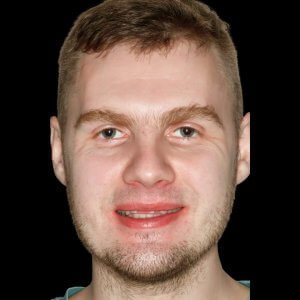
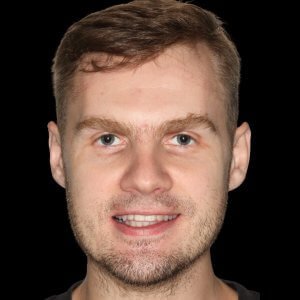
At LASER DENTAL, many international patients seek treatment not only for missing teeth, but also for the emotional and functional challenges that follow unsuccessful dental procedures. One such case involved Mr. Chegurov, a Russian patient who presented with a complex esthetic and implant-related complication in the maxillary anterior region.
This case demonstrates how digital dentistry, prosthetic planning, and biologically guided rehabilitation can be combined to restore both esthetics and patient confidence in situations with severe tissue compromise.

Initial Presentation
Mr. Chegurov arrived at LASER DENTAL after experiencing failure of a previously placed dental implant in the upper anterior region. One of the implants had recently exfoliated, resulting in significant hard and soft tissue loss around the affected area.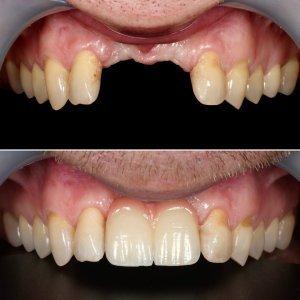
At the time of presentation, the patient was using a removable partial denture. Although functional to a limited extent, the prosthesis failed to meet his expectations in terms of comfort, stability, and appearance. As a young and socially active individual, he expressed a strong desire for a more natural-looking and fixed solution.
Clinically, the case presented several challenges:
- Severe bone deficiency in the region of tooth no. 11
- Soft tissue recession affecting the anterior esthetic zone
- Existing implant complications and altered gingival architecture
- Psychological dissatisfaction associated with removable prosthesis use
The patient’s primary concern was achieving a fixed restoration that would look natural while maintaining long-term stability.
Diagnostic Evaluation and Digital Planning
A comprehensive clinical examination was performed alongside CBCT analysis to evaluate the available bone volume and surrounding anatomical limitations.
The CBCT findings revealed extremely limited residual bone in the region corresponding to tooth no. 11, making conventional implant placement highly challenging without extensive augmentation procedures.
Instead of pursuing an aggressive surgical approach, a digitally guided prosthetic-driven treatment plan was developed.
Using a fully digital workflow, the case was designed in EXOCAD to optimize esthetics, biomechanics, and tissue support simultaneously.
The treatment plan included:
- A screw-retained zirconia crown restoration for tooth no. 21
- A titanium-supported crown restoration for tooth no. 11
- Customized prosthetic contours to compensate for soft tissue collapse
- Integration of pink porcelain to recreate the natural gingival emergence profile
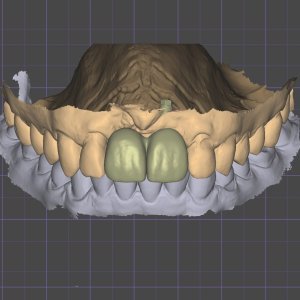
This approach allowed us to restore the missing tissue architecture prosthetically while minimizing additional surgical trauma.
Prosthetic Design Considerations
One of the most critical aspects of this case was managing the visible tissue deficiency in the anterior maxilla.
Following implant failure, both bone and gingival tissues had undergone significant resorption. Rebuilding the natural appearance of the smile therefore required more than simply replacing missing teeth.
Pink porcelain was strategically incorporated into the prosthetic design to simulate the natural gingival contour and restore the visual height harmony between teeth no. 11 and 21.
This technique enabled:
- Improved smile symmetry
- Enhanced lip support
- More natural transition between prosthesis and soft tissue
- Reduced visibility of underlying tissue defects
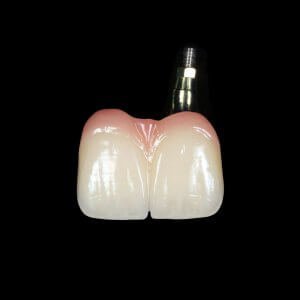
Careful shade matching and contouring were performed to ensure seamless integration with the patient’s natural dentition.
The final restorations were fabricated using zirconia and titanium-supported components to maximize both esthetic quality and structural durability.
Treatment Outcome
Following insertion of the definitive restorations, the patient reported immediate improvement in comfort, confidence, and overall satisfaction.
Functionally, the fixed solution eliminated the instability associated with removable dentures. Esthetically, the digitally designed restorations restored the patient’s smile line, facial balance, and anterior tooth proportions.
The combination of digital planning, implant prosthodontics, and tissue-mimicking restorative materials allowed rehabilitation of a highly compromised anterior implant case without extensive reconstructive surgery.
Most importantly, the treatment restored the patient’s confidence in smiling and social interaction — an outcome that often carries equal importance to the clinical success itself.
The Role of Digital Dentistry in Complex Implant Rehabilitation
Cases involving implant failure and tissue loss require careful interdisciplinary planning. Traditional approaches often focus solely on replacing missing teeth, while overlooking the esthetic consequences of soft tissue collapse.
Digital dentistry now allows clinicians to evaluate facial proportions, prosthetic emergence profiles, implant positioning, and restorative space before treatment begins.
In this case, EXOCAD-based digital planning played a critical role in:
- Predictable prosthetic visualization
- Accurate restorative design
- Esthetic tissue simulation
- Improved communication between clinician, laboratory, and patient
This prosthetically driven philosophy is becoming increasingly important in contemporary implant dentistry, particularly in esthetically demanding cases.
Conclusion
Implant failure in the anterior maxilla can create both biological and emotional challenges for patients. Successful rehabilitation requires more than replacing lost teeth — it requires restoration of appearance, comfort, confidence, and oral function through a carefully planned multidisciplinary approach.
Mr. Chegurov’s case highlights how digitally guided implant prosthodontics and advanced restorative materials can provide predictable outcomes even in severely compromised conditions.
At LASER DENTAL, our focus remains on combining modern digital workflows with patient-centered treatment planning to achieve functional, esthetic, and long-lasting results for both local and international patients.